Pension Sharing in Divorce: What the 2026 Reform Means for Your Settlement
Key Takeaways
- 71% of divorce settlements ignore pensions entirely — yet pensions are often worth more than the family home (2026 Gender Pensions Gap Report).
- The Government's "A Fairer End to Relationships" consultation closes 14 August 2026 — proposed reforms would give pensions greater weight in financial settlements.
- A clean break order does not automatically divide pensions — you need a Pension Sharing Annex in your consent order, or you risk walking away from your largest asset.
Your divorce doesn't end your financial ties. And when it comes to pensions — often the largest asset in a marriage after the family home — what you don't know can cost you a significant sum in retirement.
Yet the numbers are stark: according to the 2026 Gender Pensions Gap Report, 71% of divorce settlements fail to address pension assets at all. A separate Standard Life study (May 2026) found that 73% of couples have never even discussed how their pensions would be handled if they separated. And a Legal & General survey of nearly 3,000 divorced UK adults (fieldwork October–November 2024, published April 2025) revealed that 29% actively turned down a share of their partner's pension — with women more likely to waive their rights than men.
Meanwhile, the Government has launched "A Fairer End to Relationships" — the most significant consultation on divorce financial law since the Matrimonial Causes Act 1973. It closes on 14 August 2026, and pension sharing is at the heart of the proposed reforms.
If you're going through a divorce in England and Wales right now, this is the single most important topic you need to understand before you sign anything.
Why Pensions Are the Most Overlooked Asset in Divorce
When couples divorce, they instinctively focus on the family home — it's tangible, it's where the children live, and it needs to be dealt with immediately. Pensions, by contrast, feel abstract. You can't see them, you can't touch them, and the money won't be accessible for years or even decades.
But here's the reality: for many couples — especially those over 40 — pension wealth is worth more than their property equity. A defined benefit pension from 25 years of public sector employment can easily have a Cash Equivalent Transfer Value (CETV) of £300,000 to £500,000 or more. And unlike a house, where the mortgage reduces the net value, a pension's full CETV is an asset that belongs to the marriage.
The Money and Pensions Service found that only 43% of UK adults even know that pensions form part of a divorce settlement. Among those who do, many still choose to ignore them — either because the process seems too complicated, because they're trading pension rights for the house (often a poor deal), or because their DIY divorce service simply doesn't handle pension sharing.
The Three Ways Pensions Can Be Divided in Divorce
Understanding your options is the first step. There are three main approaches to dividing pensions in a divorce in England and Wales, and the right choice depends entirely on your circumstances.
| Method | How It Works | Clean Break? | Best For |
|---|---|---|---|
| Pension Sharing Order | A court order transfers a percentage of one spouse's pension into a new pension in the other spouse's name. The transfer is permanent and irreversible. | Yes — full clean break | Most divorces where pensions are a significant asset. The preferred method since 2000. |
| Pension Offsetting | One spouse keeps the pension; the other receives a larger share of other assets (typically the house) to compensate. | Yes — but risky | Situations where one party strongly prefers to keep the home. Requires careful valuation — house prices and pension values don't move in the same way. |
| Pension Attachment Order | The pension provider pays a portion of the pension income (or lump sum) to the ex-spouse when the pension holder retires. | No — ongoing link | Rarely used. Doesn't provide a clean break — payments stop if the pension holder dies or the recipient remarries. |
For most couples, a Pension Sharing Order is the cleanest and most effective option. It gives each person their own pension pot, free from any future connection to their ex-spouse. The tax wrapper survives the transfer — meaning the pension credit remains tax-advantaged and grows in the recipient's own name.
What Is a CETV — and Why It Matters More Than You Think
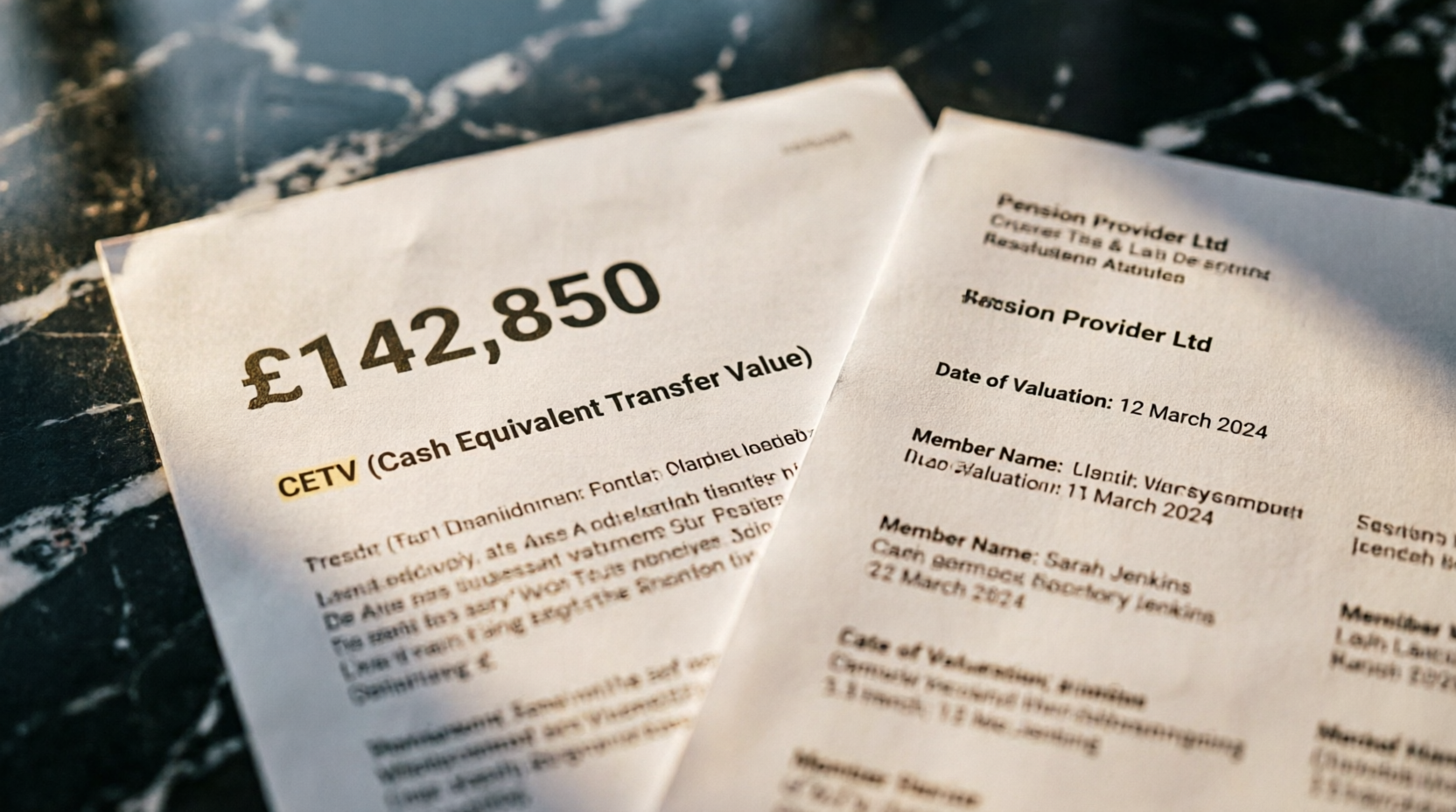
The Cash Equivalent Transfer Value (CETV) is the figure used to place a monetary value on a pension for the purposes of divorce. Every pension provider in the UK is legally required to provide a CETV on request, and it must be obtained before any pension sharing agreement can be reached.
For defined contribution pensions (personal pensions, stakeholder pensions, SIPPs), the CETV is usually straightforward — it's the current value of the investment pot.
For defined benefit pensions (final salary schemes, career average schemes, most public sector pensions including NHS, teachers', civil service, police, and armed forces), the picture is more complex. The CETV is calculated by the scheme's actuary and is meant to represent the present-day value of a guaranteed future income. But here's the critical point that catches most people out: CETVs for defined benefit pensions frequently understate the true value of the benefits, sometimes significantly.
This is exactly why the Pension Advisory Group (PAG) recommends that where combined pension assets exceed £100,000, couples should consider instructing a Pension on Divorce Expert (PODE) — an independent financial specialist who can analyse whether a CETV accurately reflects the pension's worth. A PODE report typically costs £1,500–£3,000 but can identify tens of thousands of pounds in pension value that a raw CETV comparison would miss.
The "I'll Keep the House, You Keep the Pension" Trap
This is one of the most common — and most dangerous — mistakes in divorce settlements. It sounds fair on the surface: one person takes the family home, the other keeps their pension. But the two assets are fundamentally different.
A house is a depreciating asset in real terms once you factor in mortgage payments, maintenance costs, insurance, and council tax. A pension — particularly a defined benefit pension — is a guaranteed income for life, often index-linked and payable from a set retirement age. Trading one for the other without expert valuation is like comparing apples with a lifetime supply of oranges.
Consider this example:
Sarah and James, both 52, divorcing after 25 years of marriage.
- Family home worth £350,000 with £120,000 remaining on the mortgage — net equity: £230,000
- James's NHS pension CETV: £280,000 (but the true value of guaranteed income could be significantly higher)
- Sarah's small personal pension: £45,000
If Sarah takes the house and James keeps his pension, she gets £230,000 in equity — but she still has a mortgage to pay, maintenance costs, and no guaranteed retirement income beyond her £45,000 pot. James, meanwhile, retains a pension that will pay him a guaranteed income of perhaps £18,000–£22,000 per year for life from age 60, plus a tax-free lump sum.
Twenty years from now, the financial gap between them could be enormous. This is why pension offsetting — while sometimes appropriate — should never be agreed without professional advice on the true long-term value of both assets.
The 2026 Reform: What "A Fairer End to Relationships" Means for Your Pension
In June 2026, the Ministry of Justice launched "A Fairer End to Relationships" — the most significant consultation on divorce financial law in over 50 years. The consultation brings together three connected areas of reform: financial remedies on divorce, financial provision for cohabitants, and inheritance protections for cohabitants.
For anyone divorcing now or in the near future, the most important proposals relate to how courts should approach financial settlements. Currently, the law governing financial orders on divorce dates back to the Matrimonial Causes Act 1973, supplemented by decades of case law that most people — and many lawyers — find opaque and unpredictable.
The consultation proposes a "codification-plus" model that would:
- Put established case law principles (like "needs" and "sharing") into statute for the first time
- Create a clearer, staged framework for how courts assess financial settlements
- Explicitly prioritise housing, income, and pension needs as core considerations
- Introduce the concept of qualifying nuptial agreements (pre-nups and post-nups with legal force)
The emphasis on pension needs is particularly significant. Research from the Fair Shares Project found that women — especially domestic abuse survivors — are disproportionately likely to have lower pensions and lower incomes after divorce. By putting pension needs into statutory language, the Government is signalling that courts should give pensions much greater weight in settlements than many currently do.
The consultation closes on 14 August 2026. While these proposals are not yet law, they represent a strong indicator of the direction family law is heading. If you're finalising a consent order right now, addressing pensions properly isn't just good practice — it's aligning with where the law is going.
Standish v Standish: The Supreme Court Ruling That Changed Pension Sharing
In July 2025, the UK Supreme Court handed down its judgment in Standish v Standish [2025] UKSC 26 — a landmark case that clarified how courts distinguish between matrimonial and non-matrimonial property on divorce.
The key ruling: the sharing principle (that matrimonial property should be divided equally) applies only to matrimonial property. Assets acquired before the marriage — including pension benefits accrued before the wedding date — do not automatically become matrimonial property simply because of the passage of time.
What does this mean in practice? If one spouse built up a substantial pension before the marriage, the portion accrued before the wedding may be ring-fenced from equal sharing — unless it can be shown that both parties treated that pension as a shared asset during the marriage.
For grey divorces involving couples who married later in life, or second marriages where one party brought significant pension wealth into the relationship, Standish has made it much harder for the other spouse to claim an equal share of pre-marital pension accrual. This makes it even more important to get expert advice on how pensions should be apportioned — distinguishing between what was built up during the marriage and what came before.
Grey Divorce: Why Pension Sharing Matters Most for Over-50s
Couples aged 50 and over now account for approximately 36% of all divorces in England and Wales — up from less than 10% in 1990. Divorce rates among women over 65 have risen by almost 40% over the past two decades. This so-called "grey divorce" trend shows no sign of slowing down.
For this demographic, pensions aren't just one asset among many — they're often the central asset. After decades of employment, pension wealth can dwarf savings, investments, and even property equity. And with retirement potentially just 5–15 years away, there's far less time to rebuild a pension pot if it isn't divided fairly now.
Yet the data shows that over-50s are among the least likely to seek professional financial advice during divorce. A Legal & General study found that only 8% of couples over 50 consult a financial adviser during their separation. The result is predictable: women in this age group face the sharpest drops in retirement income, with divorced women holding on average 61% less pension wealth than divorced men.
If you're over 50 and divorcing, pension sharing isn't optional — it's the most consequential financial decision you'll make.
How to Choose a Consent Order Service That Handles Pensions Properly
Online consent order services have made the process far more affordable and accessible — and for most couples with straightforward finances, they're an excellent option. But when it comes to pension sharing, the quality of service varies dramatically. Some providers handle it well; others don't handle it at all.
The key differences to look for:
Does the service include pension sharing as standard? Some fixed-fee consent order services explicitly exclude pension sharing — their standard package is "not suitable if you want a pension sharing order included." Others offer it but bury the option on secondary pages, so you won't find it unless you already know to ask. The best services make pension sharing a visible, prominently priced part of the offering.
Is the Pension Sharing Annex drafted correctly? Pension sharing requires specific drafting — a Pension Sharing Annex must accompany the consent order, formatted with the correct percentage, the pension provider's details, and the implementation date. Errors in this annex are one of the top reasons consent orders are rejected by the court.
What happens if something goes wrong? Look for services that check your consent order against known court rejection criteria before submission — not ones that simply promise to fix problems after rejection (which can add 4–8 weeks of delay).
Before you commit to any service — online or solicitor — ask these three questions:
- Does the fixed fee include a pension sharing annex, or is it an add-on?
- Will the consent order include the correct pension sharing provisions and recitals?
- What happens if the court rejects the order because of pension-related errors?
How Much Does Pension Sharing Cost in a Consent Order?
The costs associated with pension sharing in a consent order break down into several components:
| Cost Item | Typical Range | Notes |
|---|---|---|
| CETV Request | Free | All UK pension providers must provide a CETV on request at no charge. |
| PODE Report | £1,500–£3,000 | Recommended by PAG where combined pensions exceed £100,000. Essential for defined benefit schemes. |
| Consent Order with Pension Sharing Annex | £399–£1,200 | Online services: £399–£799. Solicitors: £750–£1,200+VAT. Fixed-fee services vary widely. |
| Court Fee (Consent Order) | £62 | Standard HMCTS fee as of 13 July 2026. |
| Pension Provider Implementation Fee | £0–£3,500 | Varies by scheme. Some charge nothing; defined benefit schemes can charge £2,000–£3,500. |
The total cost of including pension sharing in your consent order will depend on the complexity of your pensions and whether you need a PODE report. For straightforward defined contribution pensions, the additional cost may be minimal. For complex defined benefit schemes — especially NHS, teachers', or civil service pensions — the investment in expert analysis almost always pays for itself many times over.
What You Should Do Right Now
Whether you're at the beginning of the divorce process or about to finalise a consent order, here's a practical checklist for handling pensions properly:
- Request CETVs from every pension provider — both yours and your spouse's. This is free and is a legal requirement for Form D81.
- Don't agree to "you keep the house, I'll keep the pension" without getting independent advice on the true long-term value of both assets.
- If combined pensions exceed £100,000, seriously consider a PODE report — especially if either party has a defined benefit pension.
- Make sure your consent order includes pension sharing provisions if you've agreed to split pensions. A clean break order without a pension sharing annex does not automatically divide pensions.
- Check that your consent order service actually handles pension sharing — don't assume it's included in the standard fee.
- File before any further court fee increases — the consent order court fee is currently £62 (as of 13 July 2026), but fees are reviewed regularly.
Frequently Asked Questions
Can I get a clean break order without addressing pensions?
Technically, yes — but it's risky. A clean break order dismisses future financial claims, but if pensions haven't been properly addressed (either shared, offset, or explicitly dismissed), one party could be walking away from a significant asset. If you want a true clean break, your consent order should specifically address pension provision — either by including a pension sharing annex or by explicitly dismissing pension claims within the order itself.
My spouse has a much bigger pension than me. Am I entitled to a share?
Pensions accrued during the marriage are treated as matrimonial assets, and the court considers them when assessing whether a financial settlement is fair. There's no automatic 50/50 split — the court weighs all the circumstances, including the length of the marriage, each party's needs, and contributions (including non-financial contributions like childcare). But you do have a right to have pensions considered as part of the settlement.
How long does a pension sharing order take to implement?
After the court approves your consent order, the pension sharing order takes effect once the Final Order (formerly Decree Absolute) has been granted and a further 28 days have passed. The pension provider then has up to four months to implement the transfer, though many complete it sooner.
Will the 2026 reform change how pensions are divided?
The "A Fairer End to Relationships" consultation proposes putting pension needs into statutory language and creating a clearer framework for how courts assess settlements. If enacted, this could result in pensions being given greater weight in financial orders. However, the consultation closes on 14 August 2026 and any resulting legislation would take time to pass through Parliament. For now, the existing law under the Matrimonial Causes Act 1973 applies.
What is the Standish ruling and does it affect me?
Standish v Standish [2025] UKSC 26 clarified that the sharing principle applies only to matrimonial property. Pension benefits accrued before the marriage may be treated as non-matrimonial and ring-fenced from equal sharing. This matters most in grey divorces or second marriages where one party brought significant pension wealth into the relationship. For pensions accrued entirely during the marriage, the ruling has less practical impact.
Ready to protect your pension in your financial settlement?
ConsentReady generates court-compliant Consent Orders — including Pension Sharing Annexes — for a fixed fee. No hidden costs, no hourly billing, no surprises.
This article is for general informational purposes only and does not constitute legal or financial advice. ConsentReady is an automated legal document generation platform, not a regulated law firm. For advice specific to your situation — particularly where pensions exceed £100,000 or involve defined benefit schemes — consider consulting a family solicitor or a Pension on Divorce Expert (PODE). Court fees, legislation, and case law referenced in this article are correct as of August 2026 but may change. The "A Fairer End to Relationships" consultation (closing 14 August 2026) contains proposals that are not yet law.
Ready to create your Consent Order?
Protect your finances for just £199 — no solicitor needed.
Check if you qualify