Can You Get a Consent Order After Your Divorce Is Finalised? (Yes — Here's How)
Key Takeaways
- Yes, you can get a consent order after your divorce is finalised — there is no time limit. Whether you divorced last year or 20 years ago, you can still apply.
- The one exception: remarriage. If either party has remarried, they permanently lose the right to apply for most financial orders against their former spouse. This cannot be reversed.
- Every day without a consent order is a day your ex can make a financial claim against your current and future assets, pension, inheritance, and income.
You divorced years ago. Maybe you agreed informally to go your separate ways. Maybe there was nothing to divide at the time. Maybe you simply didn't know you needed a consent order — because nobody told you that divorce doesn't automatically settle your finances.
Whatever the reason, you're now wondering: is it too late?
The short answer is no — it's not too late. You can apply for a consent order at any point after your divorce, and the process is exactly the same as it would have been on the day you divorced. The court doesn't care how long ago it happened. The law sets no time limit.
But there is one critical exception — and if it applies to you, you need to know about it before you go any further.
The Remarriage Trap: The One Thing That Closes the Door
Under Section 28(3) of the Matrimonial Causes Act 1973, if either party remarries, they permanently lose the right to apply for most financial orders against their former spouse — including lump sum orders, property adjustment orders, and spousal maintenance. However, due to a legislative gap, pension sharing orders may not be automatically barred by remarriage in all circumstances, as they were introduced separately under the Welfare Reform and Pensions Act 1999. In practice, this is a complex area — if remarriage has occurred or is being considered, seek specific legal advice on pension rights.
This creates a dangerous asymmetry:
⚠ The Remarriage Trap
If you remarry before obtaining a consent order from your first marriage, you lose the right to bring financial claims against your former spouse — but they retain their rights against you until they also remarry or a consent order is made. You've closed your own claims while leaving theirs wide open.
If your ex remarries, they lose the right to bring most claims against you — but your claims against them also remain open, and obtaining a consent order is still the cleanest way to achieve full mutual finality.
If you're considering remarriage and don't yet have a consent order from your first marriage, obtaining one should be treated as urgent. Once you remarry, the door closes permanently — and it cannot be reopened.
Why People Don't Get a Consent Order at the Time of Divorce
Before explaining what to do now, it's worth understanding why so many people end up in this position. It's rarely negligence — it's usually one of these situations:
"We had nothing to divide." At the time of divorce, neither party had significant assets. There was no house, no pension worth mentioning, no savings. Getting a consent order seemed pointless — what would it even say?
"We agreed everything between us." Both parties reached a clear, amicable agreement about who gets what. Perhaps they even wrote it down. It felt settled — so why involve the court?
"Nobody told us we needed one." Many people — and even some solicitors — don't adequately explain that divorce alone doesn't resolve finances. The divorce process itself doesn't require a financial order, so people assume it's optional.
"We couldn't afford it at the time." Legal fees of £1,500+ for a solicitor felt prohibitive during an already expensive divorce. It got pushed to the bottom of the priority list and never happened.
"We didn't want any more conflict." The divorce was difficult enough. Raising the topic of financial orders felt like reopening wounds. Both parties just wanted it to be over.
Every one of these reasons is understandable. And every one of them leaves financial claims wide open — indefinitely. As the Supreme Court confirmed in Wyatt v Vince [2015] UKSC 14, there is no time limit on financial claims after divorce. A claim can be brought 5, 10, or 19 years later — and the law will let it proceed.
For more on why this matters, see: Can Your Ex Claim Against You Years After Divorce?
What Has Changed Since You Divorced?
The reason a consent order matters more with each passing year is that both parties' financial positions change over time. Here's what may have happened since your divorce:
| Change | Why It Creates Risk Without a Consent Order |
|---|---|
| Your income has increased | Your ex could apply for spousal maintenance based on your current (higher) income |
| You've bought a property | Your ex could apply for a property adjustment order — even though they contributed nothing to the purchase |
| Your pension has grown | Your ex could apply for a pension sharing order against a pension built up entirely after the divorce |
| You've received an inheritance | Your ex could claim a share — particularly if they can argue their own needs have increased |
| You've started a successful business | Your ex could claim against business value — exactly what happened in Wyatt v Vince |
| You've entered a new relationship | Your new partner's assets don't become directly claimable, but your own improved living situation could be used as context for a claim |
| Your ex's circumstances have worsened | Financial hardship is a common trigger for late claims — your ex may seek support they didn't need at the time of divorce |
The more your circumstances have improved since divorce, the more you have to lose without a consent order. And the more your ex's circumstances have deteriorated, the more motivated they may become to bring a claim.
The Process: How to Get a Consent Order After Divorce
The process is identical to getting a consent order during divorce — with one simplification: you don't need to wait for a Conditional Order, because your divorce is already finalised.
- Contact your ex-spouse. A consent order requires both parties' agreement. You'll need to explain why you want one (it protects both of you equally) and agree the financial terms — which, for many post-divorce cases, is simply a mutual clean break dismissing all future claims.
- Agree the financial terms. If there are assets to divide (property acquired since, pension growth, etc.), you'll need to agree how to handle them. If there's nothing to divide, the order simply dismisses all future claims — a straightforward clean break.
- Gather financial information. Both parties need to provide current financial details for Form D81 — income, property, pensions (with CETVs), savings, and debts. Even if you had nothing at the time of divorce, your current financial position is what the judge will assess.
- Prepare the documents. Draft Consent Order (with clean break provisions) and Form D81 (version 04.25, still current as of August 2026). See: Form D81 Field-by-Field Guide
- Both parties sign. Both the Draft Consent Order and the Form D81 Statement of Truth must be signed by both parties.
- Submit to the Family Court with Form A (by consent) and the £62 court fee. Post to: HMCTS Financial Remedy, PO Box 12746, Harlow, CM20 9QZ — or via MyHMCTS if you have legal representation.
- Wait for judicial approval. 8–12 weeks typically. The judge reviews on paper — no hearing needed.
- Receive the sealed order. Your financial clean break is legally complete. All future claims are permanently dismissed.
For a complete submission checklist, see: Consent Order Checklist: Everything You Need Before You Submit
What If Your Ex Won't Agree?
This is the most common obstacle when seeking a consent order after divorce — particularly if years have passed and both parties have moved on. Your ex may not see the point, may not want to re-engage, or may actively resist because they want to preserve their right to make a future claim.
Your options:
Explain that it protects both parties equally. A clean break consent order dismisses claims in both directions. Your ex may not realise that you could equally bring a claim against them. Framing it as mutual protection rather than one-sided benefit often helps.
Mediation. A neutral mediator can help facilitate the conversation and reach agreement. Mediation is typically quicker and cheaper than contested proceedings, and courts expect you to attempt it before going to court.
Contested financial remedy proceedings (Form A). If all else fails, you can apply to the court for a financial order to be imposed. This costs £321 in court fees plus significant solicitor costs, and the process takes 12–18 months. It's the last resort — but it's available. See: Consent Order vs Financial Order: What's the Difference?
How Much Does It Cost?
The cost is exactly the same as for a consent order obtained during divorce:
| Route | Document Preparation | Court Fee | Total |
|---|---|---|---|
| Automated platform (simple clean break) | From £199 | £62 | From £261 |
| Automated platform (with property/pensions) | From £349 | £62 | From £411 |
| Solicitor | £1,000–£3,500+ | £62 | £1,062–£3,562+ |
Court fee correct as of 13 July 2026. Solicitor prices exclude VAT. If you're on a low income or receiving certain benefits, you may qualify for Help with Fees (Form EX160).
For a detailed price comparison, see: How Much Does a Consent Order Cost in 2026?
Special Considerations for Post-Divorce Consent Orders
There are a few points that apply specifically when seeking a consent order long after the divorce:
Your Financial Position Has Changed
The Form D81 requires your current financial position — not what it was at the time of divorce. If you've built significant wealth since the divorce, this will be visible to the judge (and to your ex-spouse, who also sees the Form D81). However, for a mutual clean break where both parties are simply dismissing claims, this is rarely a problem — the judge is checking that the clean break is fair, not dividing assets that were never in dispute.
Pension CETVs May Be Significantly Higher
If 10 or 15 years have passed, pension values may have grown substantially. You'll need current CETVs (free from your pension provider, allow 3–6 weeks). If both parties are agreeing to dismiss pension claims through a clean break, the judge will still want to see the CETVs to satisfy themselves that both parties understand what they're giving up. Section 10 of the Form D81 should explain why dismissing pension claims is appropriate despite the disparity (if any).
You May Not Have Your Original Divorce Documents
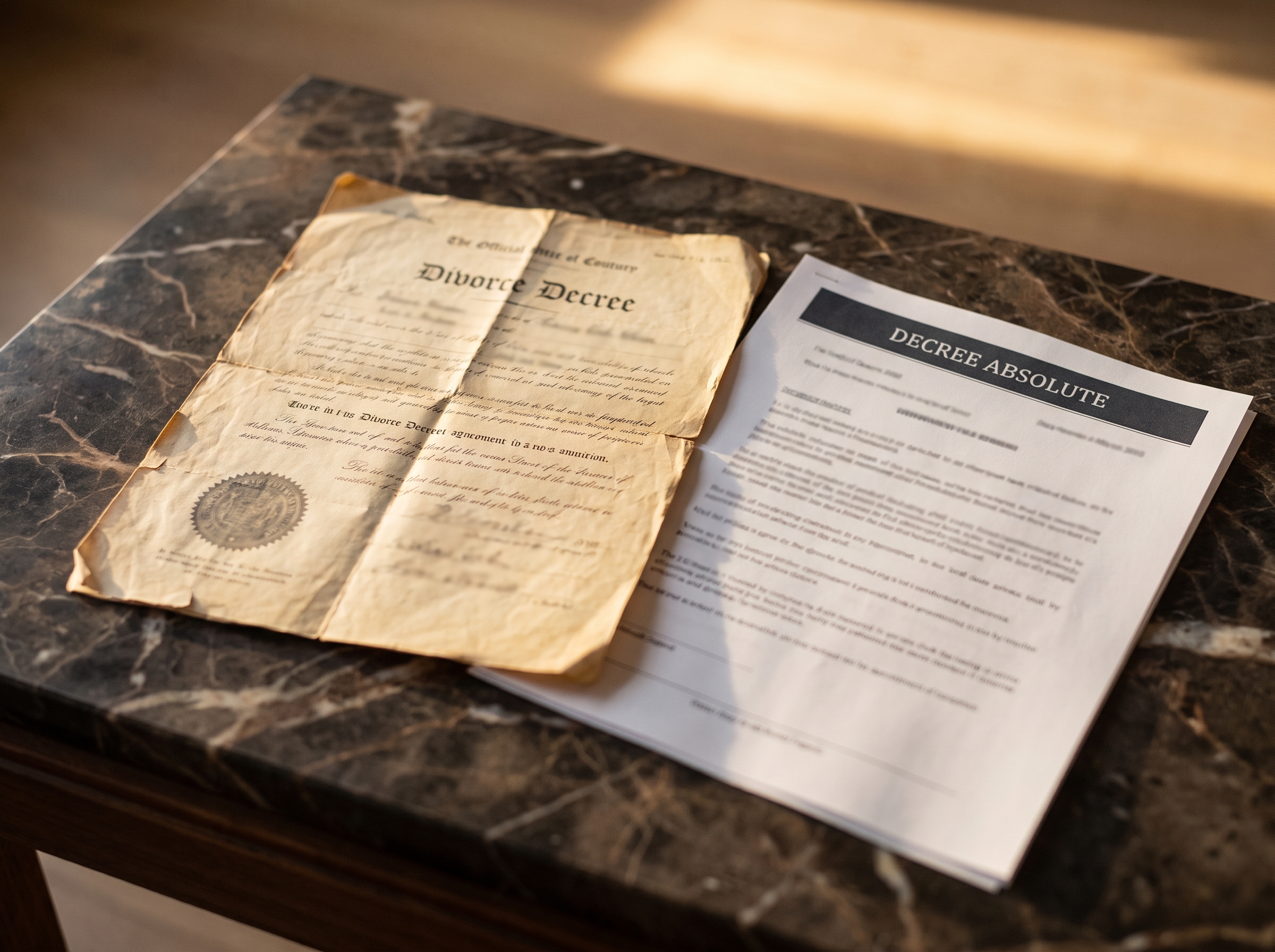
If you divorced years ago, you may not have your original divorce documents — specifically the Final Order (formerly known as Decree Absolute). For a post-divorce consent order application, the court requires this document as official proof that the marriage has legally ended before it can seal your financial agreement. You can request a copy from the court that handled your divorce, or order a search from the Central Family Court. There may be a small fee for copies, but it's a straightforward request.
Your Ex May Be Harder to Contact
If significant time has passed, you may have lost contact with your ex-spouse. You'll need their current address for the application. If you genuinely cannot locate them, the court can sometimes permit alternative service (for example, by email), but this adds complexity and delay. Try to establish contact before starting the formal process.
Frequently Asked Questions
Is there a time limit on getting a consent order after divorce?
No statutory time limit. You can apply at any point after your divorce — 1 year, 5 years, or 20 years later. The only hard deadline is remarriage: if either party remarries, they lose the right to apply for most financial orders against their former spouse.
Do I need my ex's agreement?
For a consent order, yes — both parties must agree and sign. If your ex won't agree, you can pursue a contested financial remedy application (Form A, £321 court fee), but this is significantly more expensive and time-consuming. Mediation is usually worth trying first.
What if we had nothing when we divorced but now I have assets?
This is exactly the scenario where a consent order is most important. Your ex retains the legal right to claim against everything you've built since the divorce — income, property, pension, inheritance, business value. A clean break consent order from £261 total permanently closes that door. See: Do You Need a Consent Order If You Have No Assets?
Will the court treat us differently because we divorced a long time ago?
No. The court applies the same Section 25 criteria regardless of when the divorce occurred. The judge assesses the current financial positions of both parties and checks that the proposed order is fair. The passage of time doesn't change the legal framework — but it does mean both parties' financial positions may have changed significantly since the divorce, which the judge will consider.
What if my ex has already remarried?
If your ex has remarried, they've lost the right to bring most financial claims against you. However, a consent order is still the cleanest way to achieve formal finality — it confirms the dismissal of all claims in both directions and gives you a sealed court order to rely on. And your own claims against your ex remain open until a consent order is made or you also remarry.
Can I get a consent order if I'm already in a new relationship?
Yes. Being in a new relationship (including cohabitation) doesn't prevent you from applying for a consent order from your first marriage. However, if you've remarried (not just cohabiting), you've lost the right to apply for most financial orders — which is exactly why getting a consent order before remarriage is so important.
How long will it take?
The same as any consent order: 8–12 weeks from submission to sealed order, plus preparation time (gathering CETVs, agreeing terms, drafting documents). The total process typically takes 3–6 months. See: How Long Does a Consent Order Take?
Divorced without a consent order? It's not too late.
ConsentReady generates court-compliant Consent Orders with clean break provisions — whether you divorced last month or ten years ago. From £199 for simple cases or £349 with property and pensions, plus the £62 court fee.
This article is for general informational purposes only and does not constitute legal advice. ConsentReady is an automated legal document generation platform, not a regulated law firm. The legal principles described are based on the Matrimonial Causes Act 1973 as applied in England and Wales. Court fees are correct as of 13 July 2026. For advice specific to your situation — particularly where remarriage has occurred or is being considered — consult a family solicitor.
Ready to create your Consent Order?
Protect your finances for just £199 — no solicitor needed.
Check if you qualify